Trailseeker vs. Forester: Spatial Analysis for Outdoor Enthusiasts
February 26 2026,
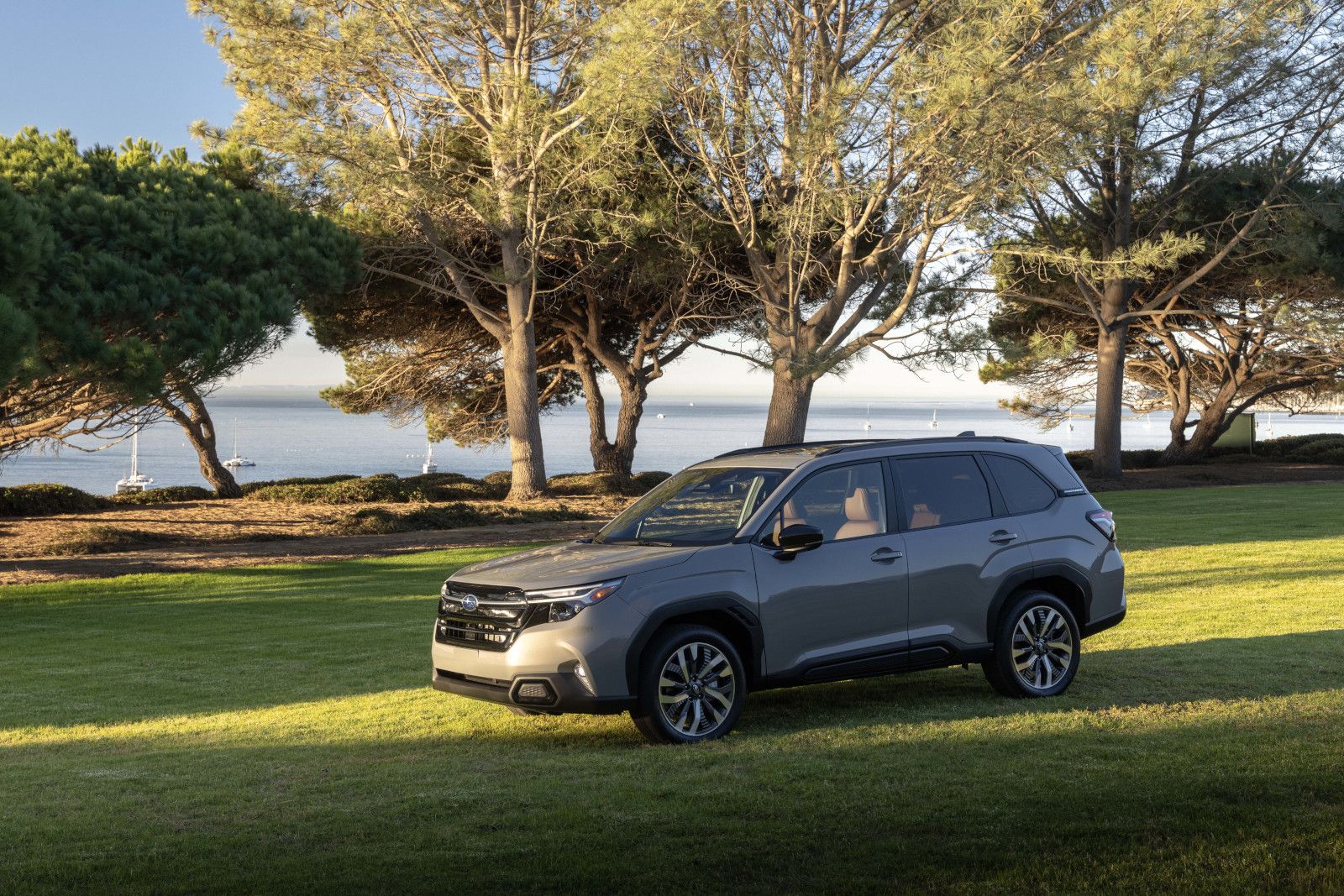
The 2026 Subaru Trailseeker and 2026 Subaru Forester offer two distinct approaches to adventure-ready SUV design. While both deliver Subaru's legendary capability, their dimensional profiles and cargo configurations serve different outdoor lifestyles. Understanding these spatial differences helps determine which vehicle aligns with your gear requirements and adventure plans.
The Trailseeker introduces Subaru's second battery-electric SUV with a focus on utility and vertical space. The Forester continues its proven formula with refined packaging and traditional proportions. Both maintain the brand's dedication to all-weather capability, but their physical dimensions create meaningful differences in how you'll load equipment and navigate terrain.
At a Glance: Trailseeker vs. Forester
|
Feature |
2026 Trailseeker |
2026 Forester |
|
Powertrain |
Dual electric motors (375 hp) |
2.5 L 4-cylinder (180 hp) |
|
Ground Clearance |
210 mm |
220 mm |
|
Towing Capacity |
1,500 kg (3,308 lb) |
680 kg (1,500 lb) |
Pricing shown reflects the price at the time of writing. Final pricing may vary.
Ground Clearance and Approach Capability
The Forester maintains 220 mm of ground clearance across all five trims, providing consistent underbody protection for rutted trails and seasonal obstacles. This 10 mm advantage over the Trailseeker's 210 mm translates to slightly better clearance over exposed roots and rocks on technical forest service roads.
Both vehicles feature Subaru Symmetrical All-Wheel Drive as standard equipment. The Trailseeker uses dual electric motors positioned on front and rear axles, delivering instantaneous torque distribution. The Forester employs a 2.5 L horizontally-opposed 4-cylinder engine producing 180 hp and 178 lb-ft of torque, paired with a Lineartronic CVT transmission and electronically controlled multi-plate transfer clutch.
The Forester's approach angle measures 19.0 degrees, with a departure angle of 24.6 to 24.7 degrees depending on trim. Its ramp breakover angle sits at 19.6 degrees. These angles determine how steep an incline you can ascend or descend without contact, critical for accessing remote campsites or navigating washouts.
Vertical Space and Roof Load Capacity
The Trailseeker stands approximately 25 mm taller than the Solterra, with additional vertical volume dedicated to rear cargo area expansion. Standard raised roof rails provide enhanced carrying capacity for rooftop cargo boxes, kayaks, or bike racks. This refined rail position increases the vertical clearance between vehicle roof and mounted equipment.
The Forester measures 1,730 mm in height with a wheelbase of 2,670 mm. Its body width spans 1,830 mm, expanding to 2,063 mm with mirrors extended. These proportions create a lower-profile silhouette compared to the Trailseeker's taller stance, affecting both aerodynamics and interior headroom.
For outdoor enthusiasts mounting gear overhead, the Trailseeker's raised rails accommodate taller cargo boxes without sacrificing garage clearance. The Forester's standard roof rails maintain a more conventional height, suitable for most aftermarket rack systems and seasonal equipment rotation.
Cargo Volume and Equipment Storage
The Trailseeker extends more than 150 mm longer than the Solterra, with this additional length concentrated in the rear section to maximize cargo space. This extended rear compartment accommodates longer items like fishing rods, camping cots, or photography equipment cases. The vertical cargo opening benefits from the vehicle's increased height, simplifying the loading process for bulky gear.
The Forester's 4,655 mm overall length and 2,670 mm wheelbase create a balanced cargo area suitable for family camping equipment and seasonal sports gear. Its contoured rear bench features flat-folding 60/40-split seatbacks on Touring and higher trims, with one-touch operation simplifying configuration changes at trailheads.
Both vehicles provide flexible interior arrangements for mixed passenger and cargo scenarios. The Trailseeker's electric architecture eliminates traditional drivetrain intrusion, potentially offering a flatter load floor. The Forester's proven packaging includes underfloor storage compartments and tie-down points for securing loose items during off-pavement travel.
Towing and Hauling Capability

The Trailseeker offers a towing capacity of 1,500 kg (3,308 lb), supporting small camper trailers, utility trailers, or boat launches. This electric powertrain advantage delivers consistent torque at low speeds, beneficial when maneuvering trailers on steep boat ramps or backing into tight camping spots.
The Forester offers a maximum towing capacity of 680 kg (1,500 lb) with trailer brakes and a maximum tongue weight of 68 kg. While lighter than the Trailseeker's 1,500 kg rating, this capacity supports small utility trailers and lightweight recreational equipment. Owners planning to tow should consult Subaru of Maple for recommended hitch and wiring packages.
Off-Road Systems and Terrain Management
Both vehicles include X-MODE terrain management systems, though with different configurations. The Trailseeker features dual-function X-MODE with Snow/Dirt and Deep Snow/Mud modes, plus Grip Control and Downhill Assist Control. These systems optimize power delivery and braking intervention for varying surface conditions.
The Forester equips standard X-MODE across all trims, with Hill Descent Control for managing steep descents. Its SI-DRIVE system offers Normal mode for efficiency-focused driving. The electronically controlled centre differential continuously adjusts torque split between axles based on traction demands.
The Forester's 10.8 m turning circle (curb-to-curb) aids navigation on narrow forest roads and tight parking situations at trailheads. Its steering ratio of 13.0:1 with 2.6 lock-to-lock turns provides responsive low-speed maneuvering.
Powertrain Considerations for Outdoor Use
The Trailseeker's 74.7-kWh lithium-ion battery delivers approximately 420 km of range from a single charge. Its NACS-compatible charge port provides access to expanding charging networks, relevant for planning extended trips to provincial parks or remote recreation areas. The dual electric motors produce 375 hp together, offering strong acceleration for highway merging and passing.
The Forester's 2.5 L Direct Injection SUBARU BOXER engine generates 180 hp at 5,800 rpm and 178 lb-ft of torque at 3,700 rpm. This naturally aspirated configuration provides predictable power delivery across elevation changes. The Lineartronic CVT transmission includes lock-up torque converter technology for improved efficiency during highway cruising.
For outdoor enthusiasts operating in areas with limited charging infrastructure, the Forester's conventional fuel system offers established refueling convenience. The Trailseeker suits drivers with access to home charging and familiarity with EV range planning for backcountry destinations.
Which SUV Matches Your Adventure Profile?
The Trailseeker's extended length, increased height, and raised roof rails create a cargo-focused platform for gear-intensive activities. Its electric powertrain eliminates fuel stops but requires route planning around charging availability. The 1,500 kg towing capacity supports light trailer duty, while 210 mm of ground clearance handles most maintained trail systems.
The Forester's 220 mm ground clearance provides a slight advantage on technical terrain, with proven reliability and conventional refueling. Its compact dimensions suit tighter trail access, while the available trim range allows budget flexibility. The lower roofline may limit oversized rooftop cargo but simplifies everyday parking and garage fit.
From expedition-style adventures requiring maximum cargo volume and towing capability to technical terrain navigation prioritizing ground clearance, both vehicles offer distinct advantages. The Trailseeker's spatial configuration and electric operation serve gear-intensive outdoor lifestyles, while the Forester's refined dimensions and conventional fuel infrastructure provide versatile adventure capability.
Find Your Subaru at Subaru of Maple
The 2026 Subaru Forester is available now at Subaru of Maple — visit us to test drive any of the five trims and experience its 220 mm ground clearance and Symmetrical All-Wheel Drive firsthand. The 2026 Subaru Trailseeker arrives Spring 2026, and pre-orders are open today. Our team can help you compare both SUVs side by side and find the one that fits your gear, your terrain, and your adventure plans.